
A container needs to move, so the shipper or freight forwarder sends the details to several providers and asks the same question:
What is your rate?
Within a few hours, several numbers arrive. The lowest quote moves to the top of the list. It appears to be a straightforward comparison.
But a complete drayage rate breakdown may reveal that those providers are not pricing the same move.
One may quote only linehaul and fuel. Another may include the chassis, a likely prepull, and the correct terminal requirements. A third may issue a low number before confirming whether a qualified carrier will perform the move at that price.
The totals look easy to compare. The services, assumptions, risks, and carrier quality behind them may be completely different.
That is why the lowest drayage quote is not always the lowest-cost option. Sometimes it is simply the quote with the most cost left outside the opening number.
Quick Answer: A complete drayage quote should identify the exact terminal and lane, linehaul, fuel, required equipment, known operating requirements, likely additional services, contingent accessorial charges, rate validity, and conditions that could change the price. Compare what each provider includes before comparing the totals.
Table of Contents
Why “Just Give Me a Rate” Creates Problems
Shippers and freight forwarders are under pressure to make decisions quickly. Sending one request to several brokers may appear to be the fastest way to identify the market price.
The problem is that a drayage rate cannot be separated from the move it is supposed to execute.
A request that says only “Chicago to customer” leaves important questions unanswered:
- Which port or rail ramp?
- Which terminal?
- Is the container available?
- What is the last free day?
- Is a chassis required?
- Where will the chassis be picked up and returned?
- Is the container standard, refrigerated, overweight, hazardous, or in-bond?
- Can the move be completed in one day?
- Is the delivery a live unload or a drop?
- Has qualified carrier capacity been confirmed?
Different providers may fill in those missing details differently. One may assume the easiest possible version of the move. Another may identify operational requirements that are likely to apply.
Both send a number, but they are not necessarily quoting the same service.
A drayage rate without clearly stated assumptions is not a complete price. It is a starting number.
A specialized drayage freight broker should be able to explain the move behind the number, not simply provide a total.
What a Drayage Rate Should Include
A reliable quote starts with complete shipment information. Each detail can affect the carrier required, equipment needed, time involved, and likelihood of additional charges.
| Rate factor | Why it matters |
|---|---|
| Exact port, rail ramp, and terminal | Distance, access, appointments, chassis arrangements, and carrier coverage vary by location. |
| Origin and destination | Mileage, facility restrictions, operating time, and delivery requirements affect the rate. |
| Container size and type | A 20-foot, 40-foot, refrigerated, or specialized container may require different equipment. |
| Weight | Overweight containers may require a tri-axle chassis, permits, or specialized capacity. |
| Commodity | Hazardous, refrigerated, regulated, or high-value goods may require added qualifications or handling. |
| In-bond status | In-bond shipments require a properly authorized bonded carrier. |
| Chassis requirements | Chassis source, daily cost, availability, and return location can affect the price. |
| Container availability | A container on hold cannot be treated the same as one ready for pickup. |
| Last free day | The deadline affects how quickly capacity must be secured and whether a prepull is advisable. |
| Pickup and delivery appointments | Limited or mismatched windows may require added planning or storage. |
| Delivery method | A live unload and a drop-and-retrieval move involve different amounts of driver time and truck movement. |
| Prepull requirements | The container may need to leave the terminal before its final delivery appointment. |
| Storage | Overnight holding can add storage and additional chassis days. |
| Chassis split or flip | Equipment pickup, return, or container transfer may require additional handling or positioning. |
| Carrier availability | The number of qualified carriers available affects current spot pricing. |
| Rate validity | A carrier’s price may expire if the customer waits too long to award the shipment. |
| Potential accessorials | Some charges are known upfront, while others depend on what happens during execution. |
The exact terminal is particularly important. “Chicago” may mean a specific rail ramp in Joliet or another facility with different mileage, equipment arrangements, appointments, and carrier coverage.
A broker cannot confidently honor a terminal-specific price when the wrong terminal was used to build it.
The Four Parts of a Complete Rate Breakdown
A useful quote should separate four different cost layers.
1. Base Transportation
The base transportation charge normally includes:
- Linehaul
- Fuel
- The defined terminal, origin, and destination
- Standard pickup and delivery under the stated assumptions
This is the foundation of the rate, but it is not always the complete expected cost of the move.
2. Required Equipment and Qualifications
Some requirements should be known before the load is awarded.
These may include:
- Chassis
- Reefer equipment
- Tri-axle chassis
- Overweight permits
- Hazmat-qualified capacity
- Bonded-carrier authority
- Specialized handling or equipment
These are not surprise charges when the shipment details already make them necessary.
3. Predictable Operating Requirements
Other services may not apply to every move but can often be anticipated from the delivery distance, appointments, terminal rules, or equipment arrangement.
Examples include:
- Prepull
- Overnight storage
- Chassis split
- Chassis flip
- Drop and later retrieval
- Additional truck movement
- Equipment repositioning
- Added stops already included in the operating plan
A prepull is a good example. A customer may prefer to avoid it because it adds an immediate charge. But when the terminal, distance, and delivery appointment make same-day execution unlikely, skipping the prepull may lead to a missed window, overnight storage, additional chassis time, and delayed delivery.
Avoiding one visible charge can create several larger ones.
4. Contingent Accessorial Charges
Contingent charges depend on events that have not necessarily happened when the quote is issued.
They may include:
- Detention
- Demurrage
- Extended storage
- Additional chassis days
- Missed appointment charges
- Redelivery
- Driver wait time
- Charges caused by a later terminal, warehouse, or customer change
These charges cannot always be predicted or guaranteed in advance. They should still be disclosed with their rates, free-time allowances, and triggering conditions.
For a broader explanation, review the factors behind higher drayage costs and FMI’s analysis of accessorial risk in drayage planning.
What Can Change the Price?
A quoted rate can change for legitimate reasons. It can also change because the opening quote was incomplete.
Understanding the difference matters.
Legitimate Reasons a Rate May Change
The shipment information changed or was incomplete:
- The wrong terminal was provided.
- The destination changed.
- The container weight increased.
- Hazmat or in-bond status was not disclosed.
- The move changed from live unload to drop.
- A reefer or specialized chassis became necessary.
- The delivery appointment changed.
- The customer delayed acceptance until the rate expired.
- Carrier capacity changed before the move was awarded.
- A delay during execution triggered a valid accessorial charge.
These changes alter the move the carrier is being asked to perform.
Warning Signs of an Unreliable Quote
A rate deserves closer review when:
- The broker priced it without confirming the terminal.
- The quote does not identify what is included.
- Required equipment is missing.
- A likely service is treated as a remote possibility.
- The rate has no stated validity period.
- Capacity has not been confirmed.
- The provider frequently withdraws or revises rates after award.
- No one can explain what triggered an increase.
- The opening price appears designed primarily to win the load.
A rate adjustment is not automatically improper. But repeated repricing, unclear assumptions, and unexplained changes may indicate that the opening number was never executable.
How a Low Quote Becomes an Expensive Move
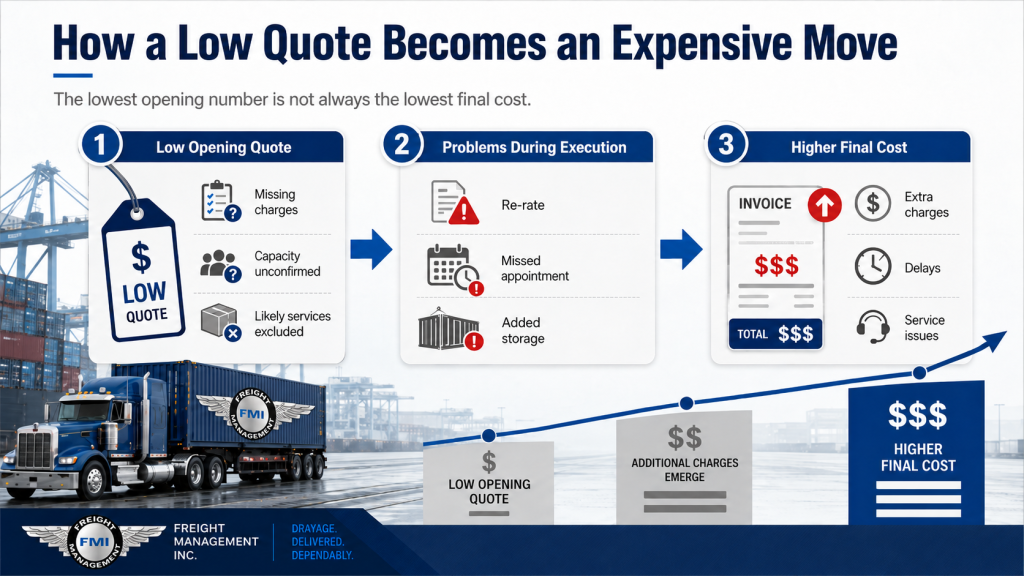
Some providers win business by making the initial total look as low as possible.
That does not always mean the provider is intentionally misleading the customer. The quote may be based on incomplete information or different assumptions. But several common shortcuts deserve attention.
Known Costs Are Left Outside the Opening Rate
A provider may know that a reefer, chassis, prepull, split, flip, storage period, or additional movement will likely be required but list it only as a possible future charge.
The quote appears lower because less of the move is included.
The customer may assume that all providers will charge similar accessorials later, so the lowest base amount still seems like the best choice. That assumption becomes unreliable when one provider included a known requirement and another did not.
The Rate Is Issued Before Capacity Is Confirmed
Some brokers send an aggressive number first and attempt to secure a carrier afterward.
When no qualified carrier accepts the load at that amount, the broker may:
- Increase the rate
- Withdraw the quote
- Delay the booking
- Use a carrier selected mainly because it is cheap
- Attempt to avoid the commitment
Carrier markets can change quickly, so not every adjustment is preventable. The customer should still ask whether capacity is confirmed or whether the broker is quoting a target price it hopes to cover later.
Carrier Quality Is Sacrificed for Price
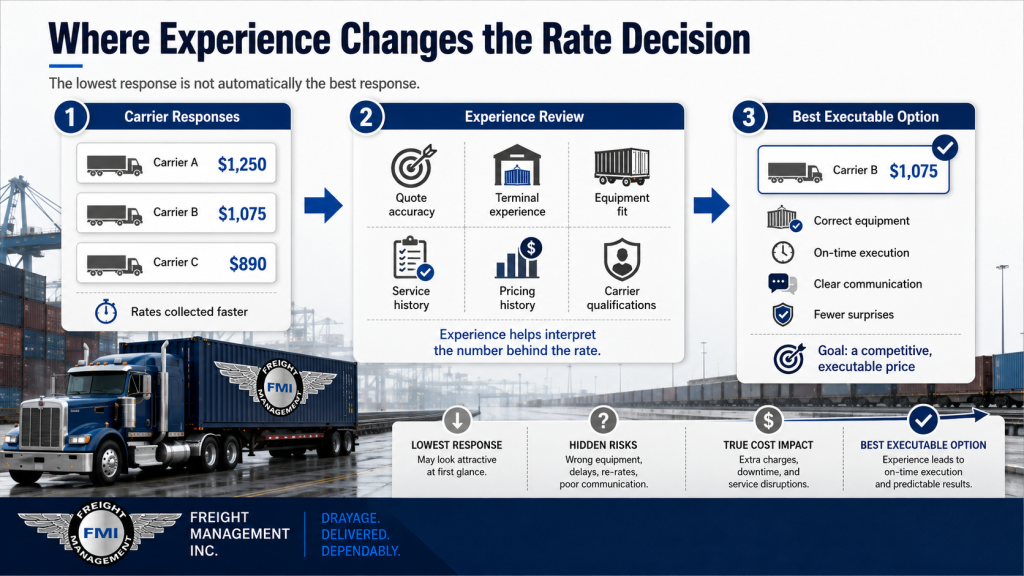
The lowest carrier response is not automatically the most dependable response.
A low-priced carrier may lack:
- Experience at the terminal
- Proper equipment
- Bonded authority
- Hazmat qualifications
- Reliable service history
- A record of honoring quoted prices
- Strong communication or documentation practices
A carrier failure can create costs that never appeared in the original quote, including missed appointments, storage, demurrage, additional handling, rebooking, and customer-service problems.
Generic Accessorial Schedules Hide the Expected Cost
Providing a long list of possible fees is not the same as explaining the expected cost of the actual move.
A transparent drayage quote should distinguish:
- Charges known to apply
- Charges likely to apply
- Charges that remain genuinely contingent
When a provider knows that a specific requirement is likely but buries it inside a generic accessorial schedule, the opening total does not give the customer a useful picture of the expected move.
Poor Carrier-Payment Practices Can Affect Capacity
A broker’s reputation with carriers can directly affect the quality and availability of the capacity it can secure.
In more serious cases, carriers may report being paid less than the agreed amount, having legitimate charges disputed after delivery, or not being paid at all. Over time, those practices can drive dependable carriers away and force the broker to rely on less-proven options, last-minute sourcing, or higher-priced capacity.
That can increase the risk of:
- Re-rates after the load is awarded
- Delayed pickups
- Missed appointments
- Service failures
- Weaker communication
- Greater exposure to storage, detention, or demurrage
Shippers and freight forwarders should look beyond the opening rate and review the provider’s credit history, carrier-payment reports, public complaints, Google reviews, BBB record, business history, and pattern of rate withdrawals or payment disputes.
The issue is not where a broker is located. The issue is whether it treats carriers fairly, pays agreed charges, and maintains the relationships needed to secure dependable capacity.
What Does “All-In” Really Mean?
Shippers and freight forwarders understandably want one number with no surprises.
The challenge is that a quote is created before every future terminal, warehouse, chassis, appointment, and delay condition is known.
An all-in rate might mean:
- All standard transportation charges are included.
- All services currently known to be required are included.
- One total is shown, but specified accessorials may still be added if triggered later.
The customer must know which definition applies.
An all-in quote should clearly state:
- What is included
- What is excluded
- Which assumptions were used
- Which services are already known
- Which charges remain contingent
- How much free time applies
- How long the rate is valid
- What shipment changes can cause repricing
“All-in” should mean clearly defined, not unlimited.
No broker can guarantee that a driver will never wait, a terminal will never place a container on hold, an appointment will never change, or a chassis will never be needed for an extra day.
The goal should be to include what is known, explain what is likely, and disclose what could still happen.
How FMI Builds and Reviews a Drayage Rate
Freight Management Inc. participates in the same carrier market as other brokers. Carriers still have to be contacted, pricing still has to be received, and the move still has to be awarded to a qualified provider.
The difference is how FMI collects, evaluates, stores, and applies that information.
1. Confirm the Actual Shipment Requirements
FMI reviews the:
- Exact terminal
- Origin and destination
- Container size and type
- Weight
- Commodity requirements
- Timing
- Appointments
- Chassis needs
- Specialized carrier qualifications
- Known or likely additional services
A quick number is not useful when it is built for the wrong terminal or wrong type of move.
2. Send Opportunities to Qualified Carriers
FMI uses Draydex to distribute rate opportunities to carriers suited to the terminal, equipment, qualifications, and lane.
3. Collect and Store the Responses
Carrier responses are organized in the system rather than remaining spread across separate emails, calls, and spreadsheets.
4. Review What Each Price Includes
FMI looks at more than the total.
The team reviews:
- Linehaul
- Fuel
- Chassis
- Equipment
- Accessorial rates
- Included services
- Exclusions
- Validity
- Whether the response matches the requested move
5. Evaluate the Carrier Behind the Number
The lowest response does not automatically win.
FMI also considers what it knows from previous interactions, including whether the carrier:
- Quoted accurately
- Honored prior pricing
- Arrived on time
- Understood the terminal
- Supplied the correct equipment
- Communicated effectively
- Executed the move as promised
6. Separate Known Costs From Contingent Costs
FMI’s goal is to show the customer what the move is already expected to require while identifying charges that depend on future events.
That may make the opening quote higher than one that excludes a likely service. It also creates a more useful comparison.
7. Move Awarded Loads Into FMI’s TMS
Once a shipment is awarded, it moves into My Freight Manager® for tracking, communication, documentation, reporting, and billing.
FMI is not trying to produce the cheapest or most expensive rate in every market. The goal is a competitive, executable price that reflects the service, carrier, equipment, and known requirements of the move.
FMI would rather explain a likely cost before the move than defend a surprise charge afterward.
Where Experience Changes the Rate Decision
Technology can gather rates faster. It cannot replace operational experience.
FMI has spent decades working with drayage carriers, ports, rail ramps, equipment providers, shippers, and freight forwarders. That experience changes how carrier responses are interpreted.
Carrier Pricing History
FMI develops knowledge of which carriers commonly serve particular lanes and what they typically charge.
A rate that falls far outside the usual range deserves additional review, whether it is unusually high or unusually low.
Quote Accuracy
FMI tracks whether carrier quotes were accurate and whether the carrier later attempted to change the amount.
That history matters when the same carrier responds to another opportunity.
Service History
A carrier’s value also depends on whether it:
- Arrived on time
- Met appointments
- Had the correct paperwork
- Understood the ramp or terminal
- Communicated delays
- Delivered as expected
- Returned equipment correctly
A low quote can lose its value quickly when service failures create storage, demurrage, customer complaints, or a missed delivery.
Equipment and Qualification Knowledge
Experience helps identify when a move requires:
- A standard chassis
- A private chassis
- A tri-axle
- Reefer capability
- Hazmat qualifications
- Bonded authority
- Overweight permits
- Specialized handling
These requirements may not be obvious to a buyer focused only on the origin, destination, and total weight.
Port and Rail Knowledge
Ports, rail ramps, and terminals do not all operate the same way.
Different facilities may have different:
- Appointment systems
- Chassis pools
- Return locations
- Flip requirements
- Gate hours
- Access restrictions
- Equipment rules
- Free-time policies
Draydex organizes the rate information. FMI’s experience helps determine whether the carrier response makes sense for the actual move.
How Draydex Speeds Up the Quoting Process
Traditional drayage quoting can involve:
- Individual emails
- Phone calls
- Repeated follow-ups
- Separate spreadsheets
- Manual comparisons of accessorial schedules
- Searching old messages for historical pricing
- Re-entering information into another system after award
FMI created Draydex because its own brokerage operation needed a more efficient way to manage that process.
Draydex helps FMI:
- Distribute rate opportunities
- Collect carrier responses
- Compare linehaul and accessorial charges
- Store rate history
- Search historical lanes
- Compare carrier options
- Review alternative routes
- Manage awarded pricing
- Move shipments into the TMS
A process that may take several hours through individual calls and emails can often be completed through FMI’s rate-management workflow in minutes, depending on the lane, carrier response, and shipment complexity.
The stored information is as important as the speed.
FMI can review past pricing, compare current responses, and identify carriers whose quotes have historically been accurate. That gives the team more context than a spreadsheet containing today’s totals alone.
Shippers and forwarders can learn more about Book Now pricing or see how one operation eliminated manual drayage booking and saved more than $50,000 in one year.
FMI has also helped a digital forwarder improve its pricing capabilities with faster access to detailed information.
Why Carrier Tariffs Often Revert to Spot Rates
Shippers and freight forwarders frequently request carrier tariffs because they want:
- Consistent lane pricing
- Easier budgeting
- Fewer quote requests
- A repeatable pricing structure
- Faster customer quotations
A tariff can provide a useful foundation. It does not guarantee that every shipment will move at the listed price.
A move may fall outside the tariff assumptions because of:
- A different terminal
- Limited carrier capacity
- Chassis shortages
- A changed appointment
- Specialized equipment
- Hazmat or in-bond requirements
- Overweight conditions
- A prepull
- A split or flip
- A longer delivery distance
- Significant market changes
A tariff can establish a pricing structure, but it does not guarantee that a qualified carrier is available to execute every move under every condition.
When the shipment or market no longer matches the tariff assumptions, the move may return to current spot pricing.
The important question is not whether the price came from a tariff or the spot market. It is whether it reflects the actual shipment and can be executed by a qualified carrier.
How to Compare Multiple Drayage Quotes
Compare the structure of each quote before comparing the total price.
| What to compare | What a complete quote should show | Warning sign |
|---|---|---|
| Exact terminal | The specific port, rail ramp, and terminal priced | Only a broad market such as “Chicago” |
| Linehaul | The core transportation charge | Linehaul is combined into an unexplained total |
| Fuel | Whether fuel is included or listed separately | Fuel treatment is not stated |
| Chassis | Chassis rate and expected number of days | Chassis is omitted even though it is required |
| Prepull | Whether a prepull is included or likely | A likely prepull appears only in the fine print |
| Storage | Location, rate, and expected duration | Overnight storage is not addressed |
| Chassis split or flip | Whether repositioning or handling may apply | Equipment requirements are left undefined |
| Specialized equipment | Reefer, tri-axle, hazmat, bonded, or overweight requirements | Required equipment or qualifications are missing |
| Detention | Free time and the charge after free time expires | No detention terms are provided |
| Demurrage | How terminal charges will be handled | Responsibility for charges is unclear |
| Other accessorials | Rates and conditions that trigger them | Only a generic list of possible fees is provided |
| Known costs | Charges already expected for the move | Known requirements are presented as remote possibilities |
| Carrier capacity | Whether a qualified carrier has been confirmed | The broker plans to find a carrier after the quote is accepted |
| Rate validity | A clear expiration date or validity period | No deadline is stated |
| Repricing conditions | Specific shipment changes that could affect the rate | The provider can revise the rate without explanation |
| Monitoring responsibility | Who tracks availability, appointments, timing, and exceptions | The customer is expected to coordinate the move |
| Invoicing | How movements and charges will be presented | Multiple disconnected invoices may need to be reconciled |
A lower base rate does not automatically mean a lower expected cost. It may simply mean the provider priced fewer parts of the move or left known requirements outside the opening total.
The Five-Point Executable Quote Test
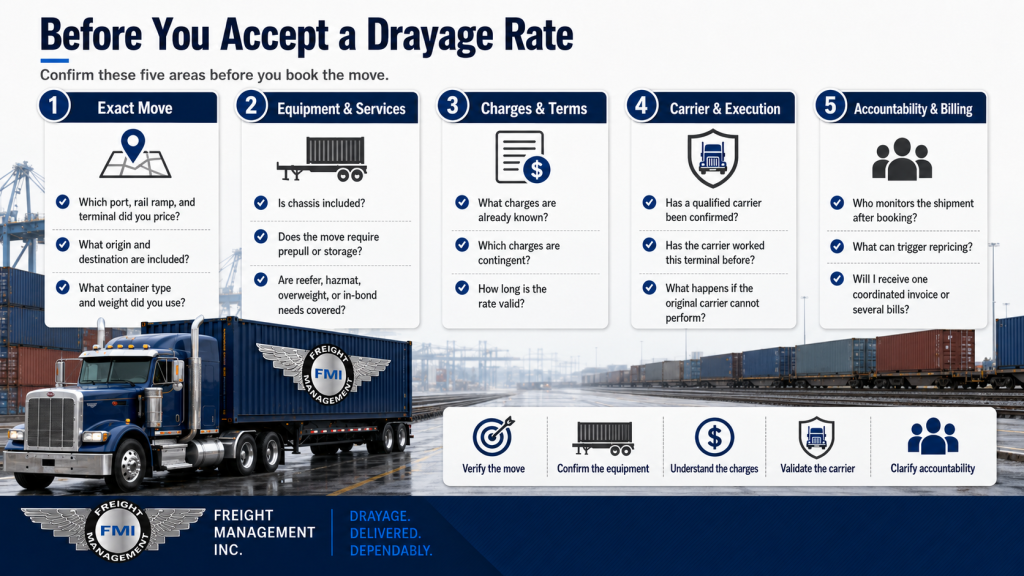
Before accepting a rate, apply these five tests.
1. Is the Exact Move Identified?
The quote should specify the:
- Port or rail ramp
- Terminal
- Origin
- Destination
- Container type
- Weight
- Relevant dates
2. Are the Correct Equipment and Qualifications Included?
Confirm whether the move requires:
- Chassis
- Reefer
- Tri-axle
- Hazmat authority
- Bonded authority
- Specialized handling
3. Are Base Transportation and Required Services Separated?
The customer should be able to distinguish linehaul and fuel from equipment and additional operating requirements.
4. Are Contingent Charges and Their Triggers Explained?
The quote should identify:
- Free-time allowances
- Potential accessorial rates
- What triggers each charge
- Which costs cannot yet be guaranteed
5. Are Rate Validity and Repricing Conditions Stated?
Confirm:
- How long the rate is valid
- Whether carrier capacity is confirmed
- Whether the price can change after acceptance
- Which shipment changes would invalidate the quote
A quote that passes all five tests gives the customer something it can evaluate, budget, and compare.
Questions to Ask Before Accepting a Rate
Ask the provider:
- Which exact port, rail ramp, and terminal did you price?
- Is fuel included?
- Is chassis included?
- How many chassis days are included or expected?
- Does the move require a prepull?
- Is overnight storage likely?
- Could a chassis split or flip apply?
- Are reefer, hazmat, overweight, or in-bond requirements included?
- How much free time applies before detention begins?
- Which additional charges are already known?
- Which charges remain contingent?
- Has a qualified carrier been confirmed?
- Has the carrier worked at this terminal before?
- Has the carrier historically honored its quoted prices?
- How long is the quote valid?
- What can trigger repricing?
- Who monitors the shipment after the rate is accepted?
- Will the shipment create one coordinated invoice or several separate bills?
- What happens if the original carrier cannot perform the move?
- Are any reasonably foreseeable services being left outside the opening total?
Businesses preparing a move can also use FMI’s five-minute Drayage Decision Checklist to review timing, availability, equipment, and accessorial exposure before booking.
Frequently Asked Questions
What should a drayage rate breakdown include?
A complete drayage quote should identify the exact terminal and lane, linehaul, fuel, chassis and specialized equipment, known operating requirements, likely additional services, contingent accessorial rates, free-time allowances, rate validity, and repricing conditions. It should also explain which carrier qualifications and assumptions were used to build the price.
Why can two drayage quotes be so different?
Two providers may use different terminals, equipment assumptions, appointment plans, carrier options, chassis arrangements, or accessorial inclusions. One quote may include a likely prepull or required chassis while another leaves it outside the opening number. Compare the shipment assumptions and line items before comparing the totals.
What does an all-in drayage rate include?
There is no universal definition of an all-in drayage rate. It may include standard transportation charges, every service currently known to be required, or one total with contingent fees still possible. The quote should define its inclusions, exclusions, assumptions, free time, validity period, and circumstances that permit repricing.
Are chassis fees included in drayage rates?
Sometimes. One provider may include chassis usage for an expected number of days, while another lists it separately. Confirm the daily charge, how many days are included, where the chassis must be picked up and returned, and whether split, flip, or extended-use charges could apply.
What are common drayage accessorial charges?
Common drayage accessorials include prepull, storage, chassis split, flip, detention, demurrage, additional chassis days, redelivery, extra stops, and drop-and-retrieval movements. The charges that apply depend on the terminal, equipment arrangement, appointment timing, delivery method, and conditions that occur while the move is being executed.
How long is a drayage rate valid?
Validity varies by carrier, lane, capacity, shipment date, market conditions, and complexity. Some carrier rates remain available only briefly, especially when qualified capacity is limited. The quote should state when it expires and whether the carrier has been confirmed or the broker still needs to secure capacity.
Why can the final invoice differ from the quote?
The move may encounter detention, storage, added chassis usage, appointment changes, terminal delays, redelivery, or other conditions that were not known when it was priced. The invoice can also change when the original shipment information was incomplete or the customer changes the terminal, equipment, dates, or delivery plan after quoting.
How should I compare drayage quotes?
First confirm that every provider priced the same terminal, lane, container, equipment, appointments, and delivery method. Then compare linehaul, fuel, chassis, predictable services, accessorial terms, carrier confirmation, rate validity, and repricing conditions. The lowest total is meaningful only when the quotes describe the same move.
Key Takeaways
- A basic rate and the expected cost of executing the move are not always the same number.
- A complete quote should address the exact terminal, equipment, carrier qualifications, timing, known services, and contingent charges.
- The lowest opening amount may exclude costs another provider has already identified as likely.
- “All-in” pricing is useful only when the inclusions, exclusions, assumptions, and validity are clearly defined.
- Technology can collect and store rates faster, but experience helps determine whether a carrier response is realistic and dependable.
- Carrier quote accuracy, terminal experience, equipment, service history, and payment reputation all affect the value behind the number.
- Shippers do not need the lowest possible price. They need the lowest dependable cost for the move they are asking someone to perform.
Know What You Are Booking Before the Container Moves
Freight Management Inc. combines specialized container drayage management, experienced carrier evaluation, Draydex technology, and shipment oversight to help shippers and freight forwarders make better booking decisions.
Use FMI’s free Drayage Decision Checklist to review container availability, last free day, equipment requirements, timing, and accessorial exposure before you book.