
To manage multi-container drayage effectively, U.S. shippers and freight forwarders need more than separate pickup plans for each container. They need one coordinated process for the different timing requirements, handoffs, exceptions, documents, and charges those containers create.
The better model is not to make every container operate the same way. It is to manage the individual moves through one accountable transportation process.
Executive Summary
A better way to manage multiple drayage containers is to keep each container’s operating requirements visible while centralizing the coordination around them. When one provider coordinates container status, appointments, handoffs, documentation, downstream transportation, and billing, the customer can manage one transportation program instead of reconstructing it across multiple disconnected providers and invoices.
What Is a Better Way to Manage Multi-Container Drayage?
A better way to manage multi-container drayage is to coordinate each container through one accountable transportation process while still monitoring its individual availability, deadlines, appointments, equipment requirements, handoffs, and charges.
The goal is not to combine five containers operationally. It is to stop making the customer coordinate five separate transportation workflows.
What Is Centralized Multi-Container Drayage Management?
Centralized multi-container drayage management is the coordination of multiple container movements through one operating structure while preserving container-level planning and visibility.
Each container can still have different requirements, carriers, appointments, accessorials, and downstream movements. What becomes centralized is the responsibility for connecting those individual decisions into one managed transportation program.
Centralized does not mean standardized.
Table of Contents
- Why Five Containers Create More Than Five Moves
- What “One Invoice” Actually Means
- What Centralized Coordination Looks Like
- Why Handoffs Make Multi-Container Drayage Harder
- What This Model Looks Like in Practice
- When a One-Provider / One-Invoice Model Makes Sense
- What to Ask Before Consolidating Multi-Container Drayage
- Key Takeaways
- Frequently Asked Questions
Why Do Five Containers Create More Than Five Moves?
A shipper may have five containers arriving at the same port, but those containers can stop behaving like one shipment almost immediately.
One may be available while another is on hold. One may have a tough time making the cutoff. Another may need a prepull because terminal timing does not line up with the receiving appointment. Some freight may require transloading before moving inland.
Each additional container creates another set of operating conditions that must be monitored:
| Container-Level Detail | Why It Can Differ |
|---|---|
| Availability | Containers may become available at different times |
| Holds | One may be cleared while another remains on hold |
| Last free day | Time-sensitive deadlines can differ |
| Chassis | Equipment requirements and usage may vary |
| Appointments | Pickup and delivery windows may not align |
| Carrier | Capacity or equipment needs may call for different providers |
| Transload | Only some freight may require another transfer |
| Downstream transportation | Destinations or transportation modes may differ |
| Accessorials | Charges depend on what occurs during each move |
| Documentation | Each movement can generate separate records |
Five containers therefore do not create only five transportation transactions. They create a network of timing decisions, exceptions, providers, records, and handoffs that somebody has to own.
Fragmented Coordination Creates the Management Burden
Using several carriers or facilities is not inherently a problem. In many moves, multiple providers are necessary.
Fragmentation becomes a problem when the shipper or freight forwarder has to stitch those providers together.
That can mean separate carrier contacts, appointment confirmations, status channels, email threads, documents, accessorial explanations, and invoices.
Knowing that a container is available does not solve the problem if its warehouse appointment conflicts with the pickup window. Knowing that freight reached a transload facility does not answer whether the linehaul provider is ready for the next leg.
This is where the role of a drayage freight broker becomes important. A broker can coordinate transportation providers and requirements without being the asset owner physically performing every stage.
The more parties involved, the more important it becomes to define who owns the connections between them.
Individual Containers Still Need Individual Decisions
Centralizing responsibility should not erase container-level differences.
If one container is available and another is on hold, they cannot be planned identically. If one reaches its LFD sooner, its pickup priority may change. If another needs a later receiving appointment or transload, its downstream plan may be different.
Individual execution. Coordinated oversight.
The goal is not to make five containers behave like one. It is to make five different container movements manageable as one transportation program.
What Does “One Invoice” Actually Mean?
One-invoice drayage is a billing structure in which transportation coordinated through one provider is presented through a consolidated customer invoice instead of requiring the customer to reconcile separate provider bills for each managed movement.
FMI’s port-to-door logistics model can coordinate local draymen, transload facilities, linehaul carriers, and final delivery while maintaining one provider relationship and invoice for the customer.
The important point is what happens before the invoice is generated.
One invoice should be the result of coordinated transportation management—not simply several unrelated charges placed on one bill.
It does not mean every container follows the same schedule or uses the same carrier. It does not eliminate accessorials or make every future cost predictable.
The individual movements and costs still exist. What changes is how the customer manages them.
Consolidated Billing Still Needs Transparency
Simplifying billing should not make the underlying charges harder to understand.
A consolidated invoice should still allow the customer to identify:
- What transportation occurred
- Which services were performed
- Which accessorials were incurred
- Why additional charges were assessed
- What documentation supports them
A complete drayage rate breakdown should establish those expectations before the move. FMI’s Five-Point Drayage Quote Transparency Framework similarly focuses on the terminal, equipment, planned services, possible additional charges, carrier requirements, and pricing conditions behind the opening quote.
That same transparency should carry through to the invoice.
A shipper should not have to choose between six separate bills and one unexplained number.
What Does Centralized Coordination Look Like?
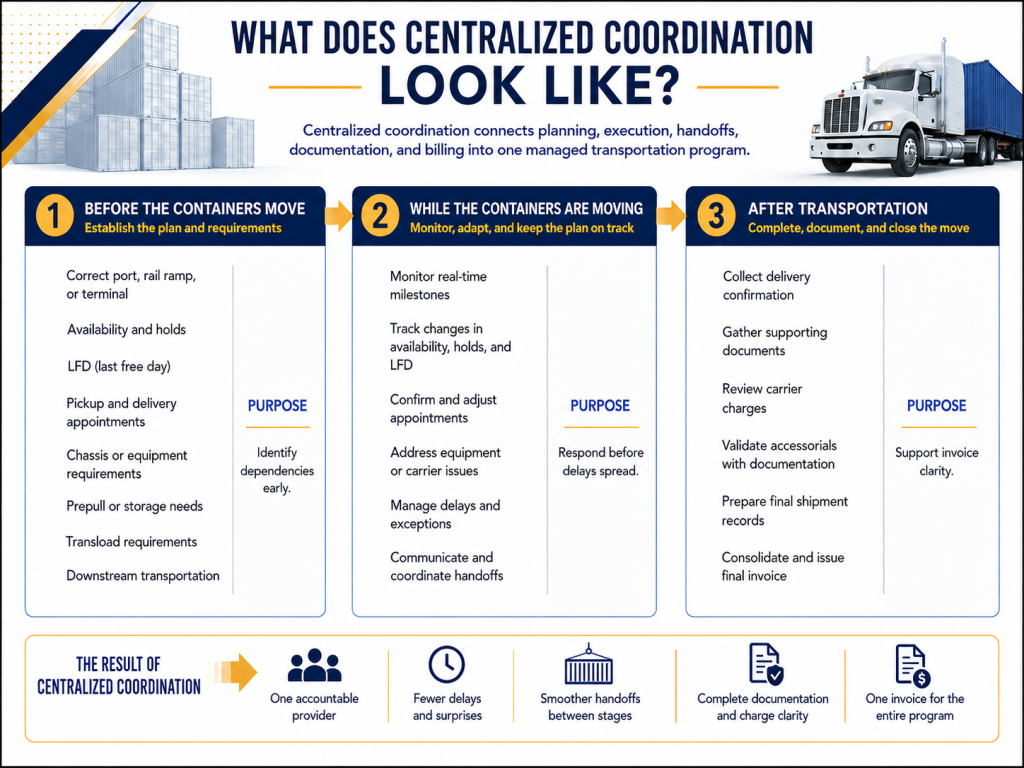
Centralized coordination connects planning, execution, handoffs, documentation, and billing instead of treating them as unrelated activities.
Before the Containers Move
The operating requirements for each container should be established before capacity is committed:
- Correct port, rail ramp, or terminal
- Availability and holds
- LFD
- Pickup and delivery appointments
- Chassis or equipment requirements
- Prepull or storage needs
- Transload requirements
- Downstream transportation
The purpose is to identify dependencies before they become exceptions.
A container can be available while the receiving facility is not. A carrier can have capacity while chassis availability creates a constraint. An earlier LFD can change the preferred pickup sequence.
For teams that need a more detailed pre-booking process, FMI’s guide on how to plan a drayage move step by step covers these requirements without needing to repeat that material here.
While the Containers Are Moving
The original plan is only the starting point.
Availability can change. Holds can clear. Appointments can move. Equipment issues can develop. A delay on one container can affect the next transportation stage.
Someone needs to monitor those changes and decide whether action is required.
FMI’s resource on what freight brokers monitor in drayage goes deeper into the operational signals that can affect a move after booking.
After Transportation
Delivery records, supporting documents, carrier charges, accessorial documentation, and final billing still have to be brought together.
This is why documentation is part of transportation management rather than an administrative task that begins after everything else is finished.
The records created during execution are what allow the customer to understand what happened and why a charge appears on the final invoice.
Why Do Handoffs Make Multi-Container Drayage Harder?
Drayage is often only one stage of the inland movement.
A shipment may follow a sequence such as:
Port or Rail → Drayage → Transload → Linehaul → Final Delivery
Each handoff creates another dependency.
Is the transload facility ready when the drayage carrier arrives? Has the downstream carrier received the information it needs? Does the delivery appointment still work? Has the required documentation followed the freight?
If an upstream delay occurs, somebody also has to determine what changes downstream.
That is where isolated problems can become program-level problems.
Shipment Visibility vs. Shipment Coordination
Visibility and coordination are related, but they are not the same.
Visibility tells you a container is available.
Coordination determines whether it should be picked up now, whether the receiving appointment works, and whether the next transportation stage is ready.
Visibility tells you a truck is delayed.
Coordination determines whether an appointment or downstream plan needs to change.
A specialized transportation management system (TMS) can improve container tracking, alerts, documentation, and workflow automation. Technology is valuable because it can surface the information needed to make those decisions.
But software does not answer the entire operating question:
Who owns the response when the information says the plan needs to change?
Technology can surface the exception. Accountability determines who acts on it.
What Does This Model Look Like in Practice?
There are two useful ways to see the difference: through real-world workflow evidence and through a simple multi-container example.
Real-World Evidence: The Cost of Fragmented Workflows
FMI published a case study involving a shipping operation that relied heavily on email-based drayage coordination and manual follow-ups.
According to the drayage booking case study, the operation reported more than $50,000 in annual savings over one year after moving to a more centralized drayage-booking workflow. FMI attributed the reported savings primarily to reduced administrative workload and improved rate visibility.
That result should not be interpreted as a promise that consolidated multi-container management will save every shipper $50,000.
What the example does show is that drayage cost extends beyond the carrier rate. Requesting rates, chasing responses, comparing information, confirming availability, and coordinating moves through fragmented processes all consume internal resources.
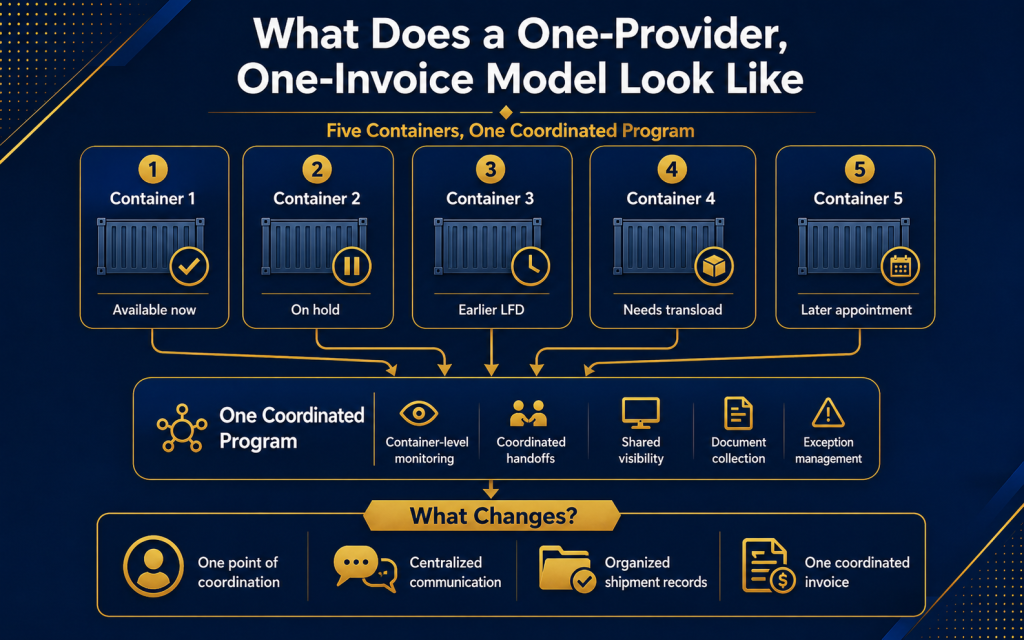
Illustrative Example: Five Containers, One Coordinated Program
Consider five import containers moving through a U.S. gateway:
- Containers 1 and 2 are available.
- Container 3 remains on hold.
- Container 4 is in a blocked area.
- Container 5 has a later warehouse appointment.
- Freight from two containers requires transloading and onward linehaul.
Under a fragmented model, the shipper or forwarder may manage the drayage providers, status checks, appointment changes, handoffs, documentation, and billing as separate workstreams.
Under a centralized model, each container still receives its own operating decisions, but one provider coordinates the relationships between those decisions.
| Fragmented Management | Centralized Management |
|---|---|
| Separate provider coordination | One coordinating provider |
| Multiple status channels | Centralized communication |
| Customer manages handoffs | Handoffs coordinated across stages |
| Separate document trails | Coordinated shipment records |
| Multiple transportation bills | One coordinated invoice |
Container 3 is still on hold. Container 4 still needs priority around its LFD. Container 5 still has a different delivery requirement.
Centralization has not changed the facts.
It has changed who has to connect them.
What this proves: Operational consolidation does not require operational sameness. It requires clear responsibility across different container conditions.
Across accounts, the pattern is that complexity concentrates where timing, providers, documents, and downstream requirements intersect.
When Does a One-Provider / One-Invoice Model Make Sense?
A centralized model is most useful when the burden of connecting multiple movements is greater than the value of managing those relationships independently.
Consider Centralized Management When
It becomes more relevant when:
- Several containers are moving simultaneously.
- Drayage is only one stage of transportation.
- Transloading, linehaul, or final delivery also require coordination.
- Multiple ports, rail ramps, terminals, or markets are involved.
- Internal transportation resources are limited.
- Availability or appointments change frequently.
- Multiple provider invoices and documents require repeated reconciliation.
Accessorial exposure also matters. Timing, chassis usage, storage, wait time, and other conditions can create additional charges when planning and execution no longer align. FMI’s resource on accessorial risk in drayage planning covers that issue in more depth.
For maritime demurrage and detention, the Federal Maritime Commission provides the more appropriate technical and regulatory reference rather than expanding that subject inside this article.
When Direct Carrier Management May Still Make Sense
A direct carrier relationship can be appropriate for a stable, straightforward lane where the customer already has strong carrier relationships and internal staff capable of managing the remaining requirements.
If the move is repetitive, handoffs are limited, and the shipper already owns the coordination effectively, another management layer may not add enough value.
The decision should be based on operating complexity—not on an assumption that one model is always better.
What This Does Not Mean
Centralized management does not mean:
- One carrier has to handle every container.
- Every container follows one schedule.
- Accessorials disappear.
- Every contingent charge can be predicted.
- Technology becomes unnecessary.
- Direct carrier relationships are inefficient.
- One invoice automatically proves good service.
One invoice alone is not evidence of a coordinated shipment.
Its value depends on the operational process behind it.
What Should You Ask Before Consolidating Multi-Container Drayage?
A provider should be able to explain how the transportation will be managed, not simply quote the movement.
| Question | What You Are Trying to Determine |
|---|---|
| Which transportation stages will you manage? | Scope |
| Who monitors each container individually? | Operational ownership |
| How are handoffs between providers coordinated? | Execution |
| How will accessorials and supporting documents be shown? | Transparency |
| Will the managed movements be consolidated into one invoice? | Administrative structure |
For broader provider-selection criteria, FMI’s guide on how to choose a drayage broker covers carrier selection, monitoring, exception management, technology, transparency, performance evidence, and accountability.
The central question remains simple:
Who is responsible for connecting the moving parts when several containers, providers, and transportation stages are involved?
One Invoice Is Really an Accountability Question
Multi-container drayage is ultimately not an invoicing question. It is an ownership question.
When several containers develop different availability dates, appointments, handoffs, documents, providers, and downstream requirements, somebody has to connect those moving parts.
A centralized model keeps the details separate where they need to remain separate while bringing responsibility for the larger transportation program together.
That is what makes one invoice meaningful: not simply that there is one bill, but that there is one accountable transportation process behind it.
Before awarding your next multi-container move, identify the timing, equipment, availability, handoff, and accessorial questions that could change the plan once the containers begin moving.
Download the Drayage Decision Checklist to work through those details before they become exceptions, added coordination work, or unexpected charges.
Key Takeaways
- Five containers can create far more than five transportation tasks because each has its own timing, equipment, appointment, exception, and documentation requirements.
- Centralized management keeps container-level decisions separate while giving the larger transportation program one coordinating structure.
- Fragmentation creates additional work when customers have to connect providers, handoffs, status channels, documents, and invoices themselves.
- Visibility tells you what is happening. Coordination determines what happens next.
- One invoice is most valuable when it reflects actual operational coordination.
- Consolidated billing should preserve accessorial and documentation transparency.
- The goal is one accountable transportation process—not one unexplained number.
Frequently Asked Questions
What is multi-container drayage?
Multi-container drayage is the management of two or more container movements involving ports, rail ramps, terminals, warehouses, or related inland transportation. Containers within the same program can still have different availability dates, holds, LFDs, chassis requirements, appointments, accessorials, and downstream transportation needs.
What is a better way to manage multiple drayage containers?
Manage each container according to its individual requirements while coordinating the overall program through one accountable process. That can centralize planning, provider communication, exceptions, handoffs, documentation, and billing without forcing every container into the same operating plan.
Can multiple drayage containers be managed under one invoice?
Yes. Multiple container movements can be coordinated through one provider and presented through a consolidated invoice when that provider manages the applicable transportation. The underlying services and charges still exist, so the invoice should preserve enough detail to explain what occurred and what produced the total.
Does one invoice mean every container uses the same carrier?
No. Different containers may require different carriers, equipment, schedules, or downstream services. One coordinating provider can manage those relationships while giving the shipper or freight forwarder a central point for communication, documentation, accountability, and billing.
Does consolidated invoicing include accessorial charges?
Yes. Accessorials can still apply because storage, chassis usage, wait time, detention, demurrage, prepulls, and other charges depend on what occurs during each move. Consolidated billing should make those charges easier to reconcile, not hide them.
Can one provider coordinate drayage, transloading, linehaul, and final delivery?
Yes, when the provider has the network and operational capabilities to coordinate those stages. The important distinction is that the coordinating provider does not have to physically perform every stage. What matters is who owns the handoffs, information, documentation, and communication between them.
What should I look for when choosing a provider for multi-container drayage?
Look for clear operational ownership. Determine who monitors each container, manages changing appointments and exceptions, coordinates handoffs, provides visibility, documents accessorials, and explains billing. A provider should be able to describe the process behind the movement—not simply give you a rate.

FMI Outlines Drayage Documentation Priorities After Court Ruling
Executive Summary: A federal appeals court decision involving detention charges during a three-day Port of Savannah closure underscores why the operating record behind a container move matters. Freight Management Inc. identifies five documentation priorities for...

How to Choose a Drayage Broker: 10 Questions to Ask Before You Book
Knowing how to choose a drayage broker means looking beyond the opening rate and determining whether the provider can actually execute, monitor, and manage the container move when conditions change. For U.S. shippers and freight forwarders, the right selection process...

FMI Releases Five-Point Drayage Quote Transparency Framework
Executive Summary: An “all-in” drayage quote may still leave important costs, conditions and operating assumptions outside the opening price. FMI’s five-point framework helps shippers and freight forwarders look beyond the total by verifying the exact terminal,...