

Updated
A drayage freight broker can speed up your short-distance logistics operation from the port or rail yard to the warehouse or consignee while saving you money.
Quick Answer: A drayage freight broker is a non-asset logistics provider that coordinates container transportation between ports, rail ramps, warehouses, transload facilities, and final delivery locations. The broker identifies qualified carriers, manages pricing and scheduling, monitors equipment and timing requirements, and gives shippers and freight forwarders one point of accountability throughout the move.
Table of Contents
- What Is Drayage?
- What Is a Drayage Freight Broker?
- Drayage Broker vs. Drayman vs. Drayage Carrier
- The Drayage Brokerage Process
- What Does a Drayage Broker Monitor During the Move?
- How Does a Drayage Broker Determine Pricing?
- Benefits of Using a Drayage Freight Broker
- How to Choose a Drayage Broker
- Frequently Asked Questions About Drayage Freight Brokers
- Key Takeaways
When it comes to logistics, efficiency, clear communication, and reasonable costs help your business keep customers satisfied. Businesses are always looking for ways to improve their supply chains, and one critical yet often overlooked area is drayage.
As goods move from ports or rail terminals to warehouses, distribution centers, transload facilities, or final delivery locations, drayage connects the different stages of the shipment. This is where the specialized experience of a drayage freight broker can become valuable.
A qualified drayage broker does more than locate a truck. The broker helps manage rates, carrier requirements, appointments, equipment, documentation, communication, and the time-sensitive details surrounding the container move.
Let’s explore what drayage is, what a drayage freight broker does, how the brokerage process works, and what shippers and freight forwarders should consider when selecting a provider.
What Is Drayage?
Drayage is the transportation of goods over a relatively short distance, typically between ports, rail yards, warehouses, transload facilities, and distribution centers. It is an essential part of intermodal transportation, connecting cargo moving by ocean, rail, and truck.
Common types of container drayage services include:
- Port Drayage: Moving containers from a marine port to a nearby warehouse, transload facility, rail ramp, or distribution center.
- Rail Drayage: Transporting containers between inland rail terminals and nearby facilities.
- Door-to-Door Drayage: Coordinating the container move from the port or rail terminal to the consignee’s location.
- Long-Haul Drayage: Moving containers farther inland when the destination is beyond the immediate port or rail market.
- Specialized Drayage: Managing overweight, refrigerated, hazardous, in-bond, or other containers with specific equipment and carrier requirements.
Drayage may appear straightforward, but each move can involve terminal rules, appointment systems, chassis requirements, container availability, free-time limits, documentation, and several parties working under tight deadlines.
What Is a Drayage Freight Broker?
A drayage freight broker is a specialized intermediary that arranges container transportation between shippers or freight forwarders and motor carriers. Unlike broad freight broker services that may cover many transportation modes, a drayage broker focuses on the requirements of port, rail, container, and intermodal moves.
A drayage broker does not need to own the truck completing the shipment. The broker works with qualified carriers and coordinates the operational details surrounding the move.
Key responsibilities may include:
- Carrier Selection and Coordination: Identifying carriers with the authority, insurance, equipment, availability, and experience required for the shipment.
- Route and Service Planning: Evaluating the available routing, terminal, transload, and delivery options.
- Regulatory Compliance: Confirming that the carrier and shipment meet applicable local, state, federal, port, and rail requirements.
- Port and Rail Coordination: Confirming the correct terminal, container availability, appointment requirements, and other facility-specific conditions.
- Equipment Planning: Identifying chassis, reefer, tri-axle, overweight, hazardous, or other specialized equipment requirements.
- Timing Management: Monitoring last free day, early return date, pickup windows, delivery appointments, and empty-return requirements.
- Rate Review: Separating linehaul, fuel, equipment, and anticipated accessorial charges so the customer understands how the quote was constructed.
- Exception Management: Responding when containers are unavailable, appointments change, chassis are in short supply, or the original operating plan can no longer be completed.
- Documentation and Visibility: Centralizing shipment records, status updates, proof of delivery, billing details, and communication throughout the move.
A drayage freight broker’s value comes from understanding the operational details that influence whether the container can be moved on time and at the expected cost.
Drayage Broker vs. Drayman vs. Drayage Carrier
The terms drayage broker, drayman, and drayage carrier are sometimes used interchangeably, but they describe different roles.
Provider | Primary role |
|---|---|
| Drayman | The driver or trucking provider physically moving a container between a port, rail ramp, warehouse, or delivery location. |
| Drayage carrier | The motor carrier providing the truck, driver, operating authority, and related equipment used to complete the move. |
| Drayage broker | A non-asset logistics provider that selects and coordinates qualified carriers while managing pricing, timing, communication, documentation, and execution. |
| General freight broker | A broker arranging one or more transportation modes but potentially without specialized port, rail, chassis, container, or accessorial experience. |
Freight Management Inc. does not operate its own fleet of trucks. As a non-asset drayage broker, FMI coordinates qualified carriers and manages the operational requirements surrounding the move.
This gives shippers and freight forwarders one responsible provider without requiring their teams to individually source, monitor, and reconcile every carrier and movement.
The Drayage Brokerage Process
Drayage freight brokers use carrier relationships, operational experience, and technology to manage the movement of containers. The process typically includes:
- Request and Assessment: The broker receives the shipment information and reviews the container, terminal, destination, timing, equipment, and handling requirements.
- Carrier Matchmaking: The broker identifies carriers suited to the location, equipment, operating requirements, and delivery schedule.
- Pricing and Rate Review: The broker gathers pricing and confirms what is included, what may be required, and what charges depend on future conditions.
- Coordination and Scheduling: Pickup, terminal, delivery, transload, and return requirements are coordinated with the parties involved.
- Monitoring and Communication: Shipment milestones are tracked, and changes or problems are communicated to the shipper or freight forwarder.
- Final Delivery and Documentation: The broker confirms delivery, gathers the required documents, and helps organize the final shipment record and billing.
Technology plays an important role in this process. At FMI, our proprietary My Freight Manager® TMS provides shipment management, visibility, and reporting.
The system can integrate with ERP, TMS, and third-party applications through digital connections such as EDI, XML, FTP, or API.
Automated notifications can inform users when orders are dispatched, picked up, delayed, or delivered. This reduces the need to repeatedly contact different parties or log into several unrelated systems for updates.
What Does a Drayage Broker Monitor During the Move?
Booking a carrier is only one part of drayage. A specialized broker also monitors the conditions that determine whether the move can be completed on time and at the expected cost.
Depending on the shipment, this can include:
- Whether the container is available or on hold
- Last free day and early return date
- Terminal and rail-ramp appointment availability
- Chassis availability and return requirements
- Chassis split or flip requirements
- Prepull and overnight storage needs
- Reefer, hazardous, overweight, or in-bond requirements
- Pickup, delivery, and empty-return milestones
- Detention, demurrage, and other accessorial exposure
- Documentation, proof of delivery, and final billing
These details are why an experienced broker may identify risks that are not apparent when a move is evaluated only by its linehaul price.
Businesses preparing an upcoming container shipment can also review FMI’s guide to planning a drayage move step by step.
How Does a Drayage Broker Determine Pricing?
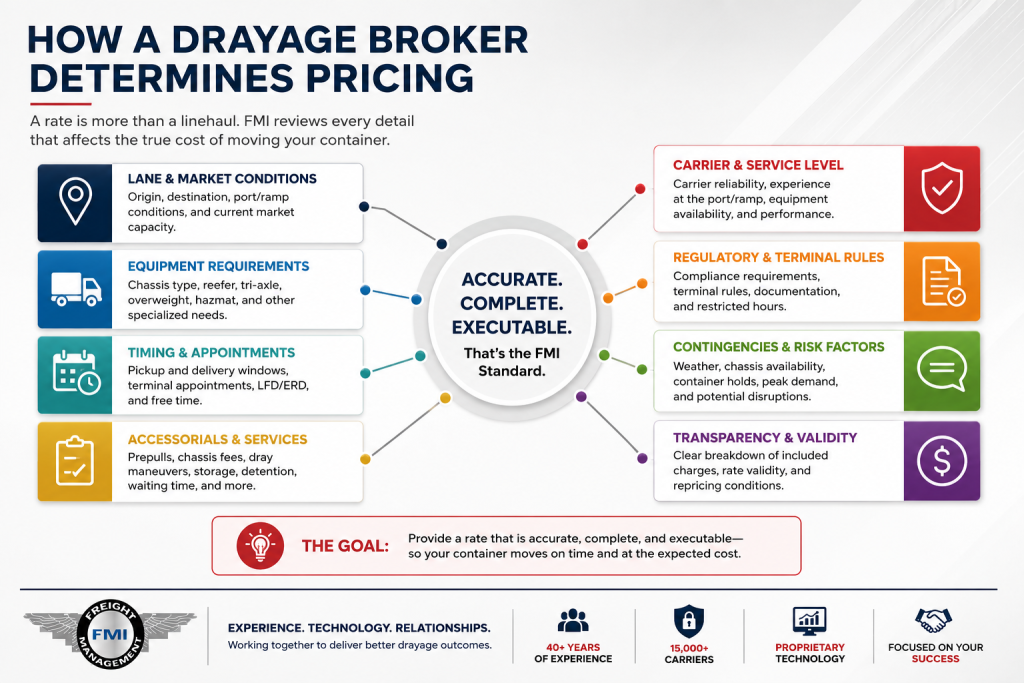
A reliable drayage quote starts with the exact requirements of the move. Broad or incomplete information can produce a rate that does not apply to the actual shipment.
For example, a quote request may say that a container is moving through Chicago. However, the price can change once the correct Joliet rail ramp or specific terminal is identified. A rate built for the wrong terminal may not be usable.
A drayage broker generally needs to evaluate:
- Exact port, rail ramp, and terminal
- Origin and destination
- Container size, type, and weight
- Reefer, hazardous, overweight, or in-bond requirements
- Linehaul and fuel
- Chassis requirements
- Pickup and delivery appointments
- Container availability and last free day
- Prepull or overnight storage requirements
- Chassis splits, flips, or equipment repositioning
- Current carrier availability
- Rate validity and acceptance timing
A basic drayage rate may primarily show linehaul and fuel. The expected cost of executing the move can also include chassis, storage, equipment positioning, prepull, and other services required by the actual shipment.
Shippers and forwarders should understand the difference between three types of charges:
- Known charges: Costs already required by the shipment details.
- Likely charges: Costs that can reasonably be anticipated based on the timing, distance, equipment, or operating plan.
- Contingent charges: Costs triggered by events that have not yet occurred, such as detention, changed appointments, terminal delays, or extended storage.
An “all-in” quote may include the services known when it is prepared, but it cannot always guarantee charges created by later operational conditions.
Transparent pricing should explain:
- What is included
- What is excluded
- What is likely to occur
- What remains contingent
- How long the rate is valid
- What circumstances could change the final amount
For a closer look at what a complete drayage rate should include, review how base transportation, equipment, predictable services, and contingent charges affect the expected cost. Or for a broader explanation of the underlying costs, read Why Is Drayage So Expensive?
FMI developed Draydex to request, manage, compare, and retain drayage rates more efficiently. Shippers and forwarders can see how FMI’s technology helped eliminate manual drayage booking and save more than $50,000 in one year.
Another FMI case study explains how a digital forwarder improved its drayage pricing capabilities by gaining faster access to line-item pricing and booking information.
Benefits of Using a Drayage Freight Broker
Cost Efficiency
- Broader Carrier Access: A broker can gather and compare pricing from carriers serving different ports, rail ramps, and markets.
- Rate Benchmarking: Historical and current pricing information can help determine whether a quote is consistent with the lane and operating requirements.
- Reduced Administrative Work: The broker manages carrier communication, pricing requests, scheduling, documentation, and follow-up.
- Better Planning for Additional Costs: Identifying likely equipment or timing requirements before booking can reduce avoidable surprises later.
Drayage brokers can also use advanced logistics software to manage rates, carrier information, shipment records, and operating data more efficiently.
Expertise and Industry Knowledge
- Port and Rail Experience: Specialized brokers understand that each terminal, ramp, appointment system, and equipment arrangement can affect execution.
- Container Knowledge: They understand how container type, weight, commodity, and documentation influence carrier selection.
- Regulatory Awareness: Brokers help identify authority, insurance, customs, in-bond, hazardous-material, and other requirements.
- Accessorial Awareness: They can explain when prepull, chassis, storage, detention, demurrage, or repositioning charges may apply.
Carrier Network and Resources
- Qualified Carrier Options: Brokers maintain relationships with carriers serving ports and inland rail ramps throughout the United States.
- Specialized Equipment Access: They can help locate carriers with reefers, tri-axles, private chassis, bonded authority, or other required capabilities.
- Alternative Coverage: When the original carrier or operating plan becomes unavailable, the broker can evaluate other options.
- Flexible Capacity: A broker can provide supplemental coverage for problem lanes, changing volume, and locations outside a shipper’s established network.
Risk Management
- Carrier Qualification: Brokers review authority, insurance, safety, and other carrier information before awarding the move.
- Exception Response: They remain involved when delays, holds, missed appointments, chassis shortages, or equipment problems occur.
- Shipment Oversight: Monitoring milestones can help teams respond before a missed deadline becomes a more costly problem.
- Centralized Communication: The shipper or forwarder has one provider responsible for coordinating the different parties involved.
Visibility and Accountability
A broker can centralize status updates, documentation, communication, proof of delivery, and billing. This is especially valuable when one customer shipment includes several containers, carriers, or related movements.
Rather than relying on separate email chains and disconnected records, the logistics team can manage multiple containers through one coordinated process.
How to Choose a Drayage Broker
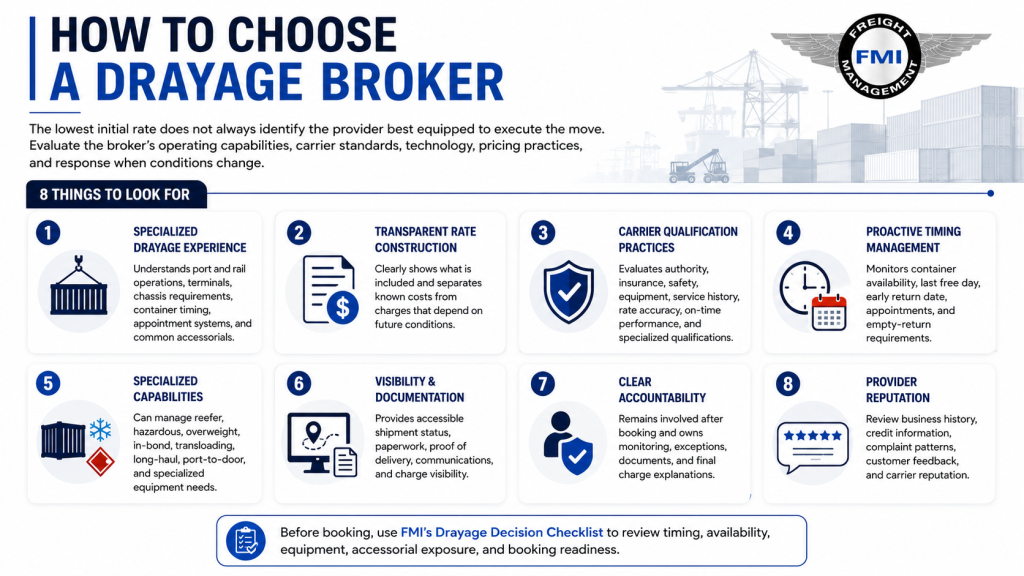
The lowest initial rate does not always identify the provider best equipped to execute the move. Shippers and freight forwarders should also evaluate the broker’s operating capabilities, carrier standards, technology, pricing practices, and response when conditions change.
Look for Specialized Drayage Experience
The provider should understand port and rail operations, terminals, chassis requirements, container timing, appointment systems, and the accessorial charges that commonly affect drayage.
A company that mainly handles other forms of freight may not have the same depth of experience with container availability, last free day, early return dates, or terminal-specific operating requirements.
Ask for Transparent Rate Construction
The quote should identify what is included and distinguish known costs from charges that depend on future conditions.
A lower opening number may not be the better value when required equipment or predictable services have been left outside the quote.
Review Carrier Qualification Practices
Ask how carriers are evaluated and how the provider monitors:
- Operating authority
- Insurance
- Safety
- Equipment
- Service history
- Rate accuracy
- On-time performance
- Specialized qualifications
Confirm Proactive Timing Management
The broker should have a process for monitoring container availability, last free day, early return date, appointments, and empty-return requirements.
These dates and conditions should not be left entirely to the carrier or customer to discover after a problem has occurred.
Check Specialized Capabilities
Confirm whether the provider can manage:
- Reefer containers
- Hazardous freight
- Overweight containers
- In-bond shipments
- Transloading
- Long-haul drayage
- Port-to-door moves
- Specialized equipment
Evaluate Visibility and Documentation
Shipment status, paperwork, proof of delivery, communications, and charges should be accessible without forcing the customer to reconstruct the move across separate emails, invoices, and carrier systems.
Require Clear Accountability
A broker should remain involved after the carrier is booked. The customer should know who is responsible for monitoring execution, addressing exceptions, collecting documents, and explaining final charges.
Review the Provider’s Reputation
Look at public reviews, business history, credit information, complaint patterns, and the provider’s reputation with customers and carriers.
A company that repeatedly withdraws rates, reprices awarded loads, uses questionable carriers, or has unresolved payment complaints deserves additional review.
Before accepting a quote, shippers and forwarders can use FMI’s free five-minute Drayage Decision Checklist to evaluate timing, availability, equipment, accessorial exposure, and booking readiness.
Frequently Asked Questions About Drayage Freight Brokers
What services does a drayage broker provide?
A drayage broker coordinates qualified carriers, pricing, scheduling, port and rail requirements, chassis planning, container availability, documentation, tracking, and exception management. The broker acts as one point of accountability between the shipper, freight forwarder, carrier, terminal, warehouse, and other parties involved in the container move.
What is the difference between a drayage broker and a drayman?
A drayman or drayage carrier physically moves the container using a truck and driver. A drayage broker is a non-asset provider that arranges and manages the move. The broker may coordinate pricing, carrier qualification, appointments, equipment, timing, communication, documentation, and problems that occur during execution.
Does a drayage broker own trucks?
Not necessarily. Many drayage brokers, including FMI, are non-asset logistics providers and do not operate their own fleets. Instead, they maintain relationships with qualified carriers and select the appropriate provider based on location, equipment, safety, availability, price, and the requirements of the move.
How does a drayage broker determine rates?
Drayage rates depend on the exact terminal, origin, destination, container type, weight, equipment, timing, appointments, chassis requirements, carrier availability, and anticipated accessorials. A complete quote should identify the base transportation cost, required services, possible additional charges, rate validity, and circumstances that could change the final amount.
How can a drayage broker improve supply-chain efficiency?
A broker can reduce the time a shipper or forwarder spends locating carriers, requesting rates, confirming equipment, monitoring milestones, gathering documents, and responding to problems. Centralized coordination also provides better visibility into the move and reduces the need to manage several unrelated providers.
How should a shipper choose a drayage broker?
Look for specialized drayage experience, transparent pricing, qualified carrier relationships, proactive monitoring, reliable technology, specialized container capabilities, clear documentation, and one point of accountability. The provider should be able to explain both the quoted rate and the operating plan behind it before the shipment is awarded.
When is a drayage broker more valuable than going directly to a carrier?
A direct carrier relationship may work for a consistent local lane with predictable volume and requirements. A broker becomes more valuable when a business manages several ports or ramps, changing lanes, specialized containers, tight timelines, multiple carriers, complex billing, or moves requiring more monitoring and coordination.
Key Takeaways
- A drayage freight broker coordinates carriers, pricing, timing, equipment, documentation, and shipment execution without necessarily owning the trucks completing the moves.
- Accurate drayage planning depends on knowing the exact terminal, container details, equipment requirements, appointments, and free-time deadlines.
- The lowest opening rate may not represent the lowest expected cost when required or reasonably foreseeable charges are excluded.
- Shippers and freight forwarders should evaluate carrier qualification, rate transparency, monitoring capabilities, technology, documentation, and accountability before choosing a drayage broker.
- FMI combines specialized drayage experience, qualified carrier access, proprietary technology, and centralized shipment management to help businesses manage container moves more effectively.
Take More Control of Your Drayage Operations
Use FMI’s free Drayage Decision Checklist to review container availability, last free day, chassis conditions, potential accessorials, and booking readiness before your next move.